


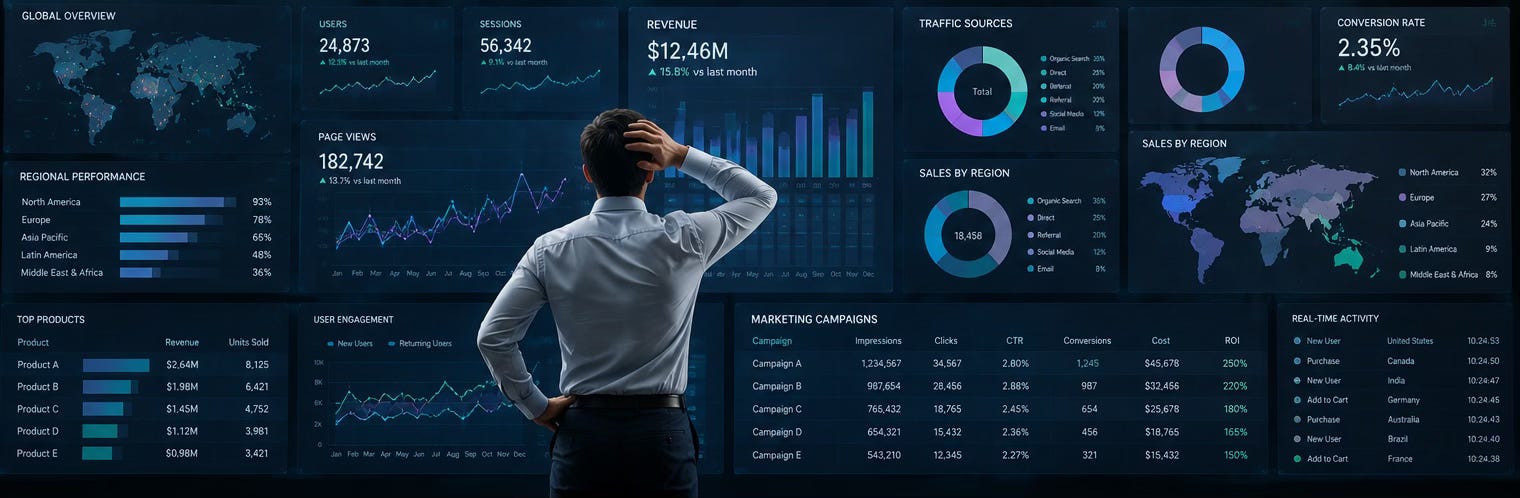
A few years ago, I walked past a seminar at a church I was visiting. On the screen, in bold letters, was the declaration: “Data is king.” I didn’t attend the session, but the phrase lodged in my mind. It captured something about one of our society’s primary driving assumptions: if we can gather enough information, we can master our lives.
If “data is king,” then the throne belongs to the person with the biggest dashboard. But the more I’ve watched our world race toward the online ecosystem, toward AI, and toward information-driven decision-making, the more convinced I’ve become that the church must say something different.
Not because information is bad.
Because information is insufficient.
Information expands human capacity, but it does not necessarily direct it. It cannot sanctify or redeem our souls, and no matter how much data we have at our disposal, it cannot by itself tell us what God wants us to do with it. So here is the counterclaim I believe Christians must recover:
Information is not king.
Revelation is king.
Information vs. Revelation
We live in an age that confuses information with wisdom. We assume that if we can just know more, we will become more. But biblically, information is never the decisive factor in human flourishing.
Information tells us what appears on the surface. Revelation tells us what is really going on. Information can tell us what our options are. Revelation gives us the truths and priorities by which those options must be judged. This distinction is woven through Scripture.
Saul Had Information. David Had Revelation.
One of the clearest examples comes from 1 Samuel 23:9–13. Saul is trying to track David down. He receives information about David’s location. He has the surface data, so he crafts a plan based on that information. David has information too, hearing that Saul is plotting against him. But David does something Saul does not.
He asks God.
David consults the Lord through the ephod. However mysterious that process may seem to us, the point is unmistakable: David does not assume that possessing information means he possesses direction.
He asks whether Saul will come.
God says yes.
Then David asks whether the men of Keilah will surrender him to Saul.
Again, God answers affirmatively.
So David leaves.
Saul has information about where David is.
David receives direction about what to do.
That is the difference.
Information Makes an Excellent Servant
Our age is drowning in information. We can track and quantify practically anything. And now, with AI, we can generate insights, summaries, predictions, and recommendations faster than we can think them. Much of this is useful. AI can summarize information, compare options, expose something we’ve overlooked, or help us ask better questions.
At the same time, we get information from other sources. Doctors explain our health condition. Financial advisers run the numbers and offer advice. Friends give us their perspective on the decisions we face.
Use information, but make it your servant, not your king.
The danger is subtle. When we enthrone information, we begin to believe that the right inputs will guarantee the right outcomes. If we are honest, we will acknowledge that many of us are now tempted to outsource our thinking and discernment to machines and algorithms.
The world we all live in now brings us back to an ancient question:
“Where can wisdom be found?
Where is the place of understanding?” (Job 28:12)
The Magi Had Information. They Still Needed Revelation.
The Magi give us another fascinating picture. Something had appeared in the heavens. They had observed it carefully enough to conclude that the King of the Jews had been born. That information got them moving, taking them all the way to Jerusalem.
But Jerusalem wasn’t their destination.
When Herod gathered the chief priests and scribes and asked where the Messiah was to be born, they turned to Scripture. Micah had already supplied the answer: Bethlehem.
The Magi had information from what they had observed. They still needed God’s revealed Word. Then, remarkably, the star appears again and leads them onward. This narrative, found in Matthew 2, lays out a pattern we must not miss:
The Magi received information, made their observations, and took action. But they did not stop there. They did not confuse what they could observe with everything they needed to know.
Information got them to Jerusalem.
Revelation got them to Bethlehem.
What Do We Mean by Revelation?
At this point, we need to be careful.
The ephod and the Magi’s star both feature means of revelation that are foreign to us today. Therefore, these narratives cannot be made to serve as templates for Christians to reproduce these types of experiences whenever we need to make a decision. As helpful as these passages are, we must be discerning:
Not every decision requires new revelation.
Most of the time, we need to apply revelation God has already given.
And that begins with Scripture.
God has already revealed His character, His purposes, and His commands in His Word. So when we need direction, the first question isn’t necessarily: “Will God give me a new message?” A better question is:
“What has God already said that governs this decision?”
Scripture may rule out an option, expose a motive, or highlight a priority we would have otherwise missed. It may tell us what kind of person we need to be even when it doesn’t tell us which job to take, which house to buy, or which city to live in.
Often, God is more interested in our character than in our precise decisions.
Here is the x-factor that only believers can leverage: When we read the Word and ponder it, the Spirit of God then works through that revealed Word—illuminating it, convicting us through it, shaping our consciences and producing wisdom.
No impression, circumstance, counsel, opportunity, or inner sense gets to outrank or contradict what God has already revealed in Scripture.
Revelation is king.
Everything else must bow.
From Information to Direction
So what does this actually look like? I think Scripture gives us a simple pattern:
(1) Gather, find out what you can—both David and the Magi began with received fact and observable phenomena.
(2) Take an additional, essential step—submit the information and yourself to God.
Our faith is not blind, but it continually calls us to a disposition of submission.
We must take all we know and bring it underneath what God has revealed.
Here is how this takes shape in our experience. We ask:
· Does Scripture rule anything out?
· What biblical priorities govern this decision?
· What motives are operating in me?
· What kind of person is God calling me to be here?
Information will often tell us that one choice is more profitable, more comfortable, more prestigious, or more efficient. Scripture asks different questions entirely:
· Which choice is faithful?
· What adjustments is God calling me to make?
· What assumptions have I been operating out of that God is prompting me to release?
The difference is profound, and it tells us why information cannot be king.
So we must ask God to expose what we’re missing, to correct our motives. We must resolve to ask Him to close doors that should remain closed and give us courage to walk through doors we would not normally enter. This means that, ultimately, we are seeking Him, not just information.
The Essential Disposition
But we must be careful to maintain a posture of humility in the process. There is a world of difference between saying, “I have prayed, searched Scripture, sought wise counsel, and believe this is where God is leading me,” and resorting to the phrase, “God told me.”
The first statement allows for humility. It leaves room for correction, for the possibility that we have misunderstood. And it keeps our impressions beneath the authority of God’s Word rather than placing them alongside it.
So the movement is simple:
Gather the information.
Submit the information to revelation.
Seek God’s wisdom and direction.
Gather.
Submit.
Seek.
AI and the New Babel
It is imperative that we examine these issues as AI becomes increasingly prevalent, as the rush toward AI has echoes of Babel—not because AI is inherently evil, but because the human impulse behind Babel is ancient and refuses to go away.
The motivation for building a tower is stark: “Let us make a name for ourselves” (Genesis 11:4). God therefore says in alarm, “Nothing they plan to do will be impossible to them” (11:6).
Note the progression:
Expanded human capacity mutates into reaching for an ability and status reserved only for God. Eventually we end up thinking that nothing can stop us.
Our achievements can inflate us. Therefore, we cannot give them a place of lordship. This means that we cannot give anything related to technology ultimate sway over our decisions. AI can summarize what Scripture says and even help us see truths in it we might have missed. But it cannot replace the Spirit who illumines Scripture and forms the people who obey it.
While it is well-known that AI can at times hand out false information, there is a greater danger. The true danger is that we might slowly become people who no longer know how to seek God.
Our invention is not our ultimate salvation.
Revelation Changes People
Revelation is not merely information from above. It is the means by which God speaks in a direct way. As a result, people who brush up against it cannot remain the same.
The Magi narrative contains a truth that the one involving David does not. After they find the Baby Jesus, they fall down and worship Him (Matthew 2:11). Similarly, after Daniel interprets Nebuchadnezzar’s dream, the king falls on his face and praises Daniel’s God (Daniel 2:46–47).
The overarching truth is undeniable: Revelation carries a transformative power that information cannot touch.
This is why we must seek Him—not only so we will know what to do, but so that we will become the people He has called us to be and can serve as agents of change in a world that world that so deeply needs it.
A Different Kind of People
As believers, we must rise above the level of others around us and maintain our distinct calling.
We do not need less information.
What we need is believers who know how to use information without bowing before it.
In an age of infinite information, people shaped by revelation are becoming increasingly rare. This means that, sooner or later, they will also become increasingly recognizable. They will not necessarily know more than everyone else, but they will know where knowledge belongs.
Looking forward into our brave new world, they are the people of value.
So while society rushes headlong toward the next source of information, let God’s people walk calmly.
Gather information.
But don’t crown it; submit it instead.
Seek God.
Because information is not enough.
Only revelation is king.
Weigh in on This One
Where do you think the greatest danger lies for Christians as we increasingly turn to AI and other electronic sources for answers—and how do you keep information from taking the place that belongs to God?
I’ll start with one concern of my own: I think AI can become so useful—and so fast—that we can gradually stop noticing when we’ve begun asking it questions we once would have taken to God. Where do you think that line is? When does a useful tool begin to become a substitute for discernment?
I'm learning that all the provisions that God gives us (people, technology, and income, for example) should be kept in their proper place. They are not meant to be the Source, and we should not look to our provisions to meet our needs. We look to God who provides for our needs. It's a mind shift.