


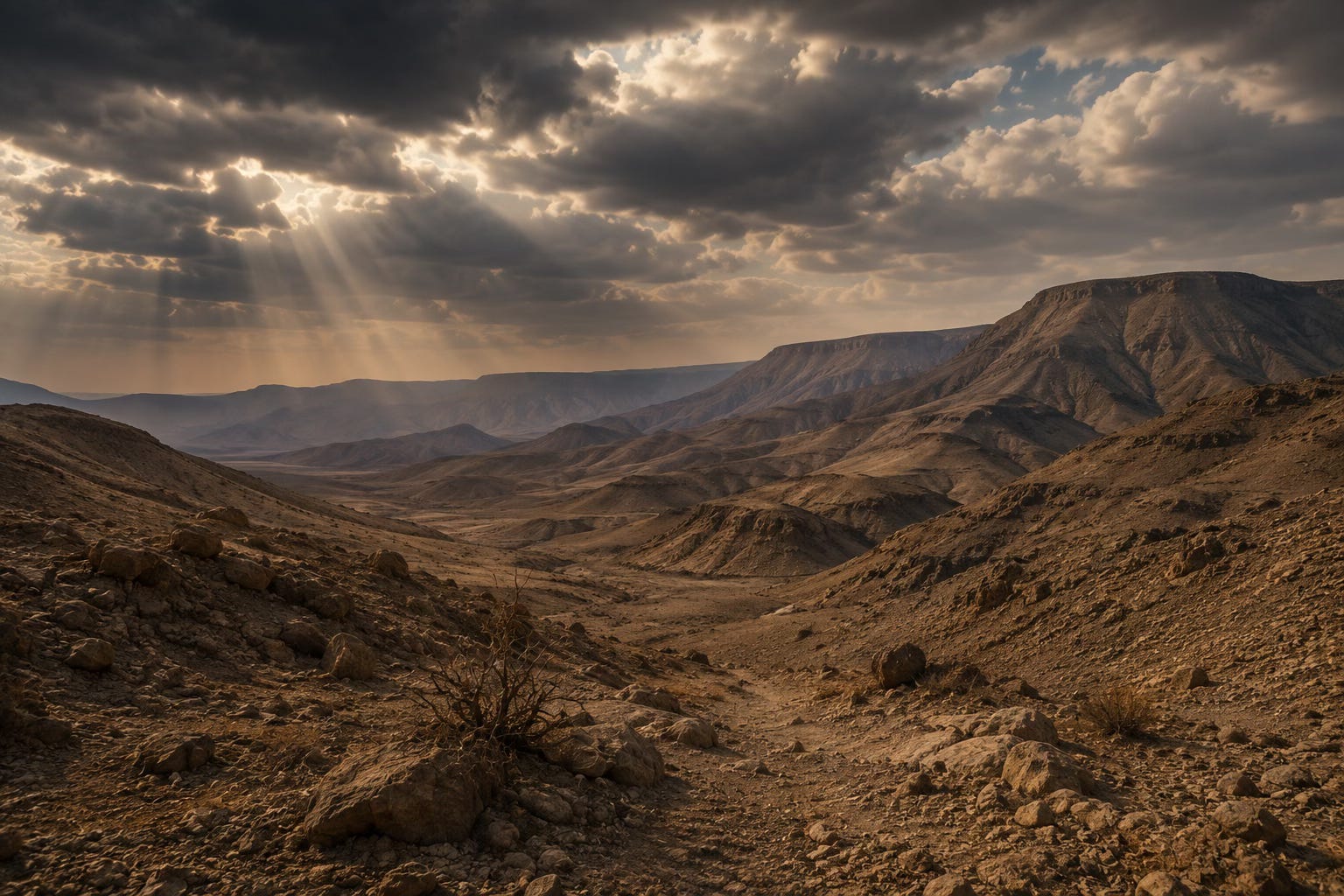
There is a worship song that came out some time ago that says that Jesus changes everything. But let’s be honest. Sometimes God leaves our circumstances exactly as they are. Things stay the same, week after week, and even year after year. If nothing changes in spite of your best intentions, you may be in a wilderness.
But here’s the important thing to know about a wilderness: God has put you there for a reason, and more, He has kept you there for a reason. But many times, our first instinct is to get out—the sooner the better. But if we expand our attention past the point of our immediate desire for relief, we may discover something far more valuable: what God intends to accomplish while we’re there.
Psalm 95 recounts part of Israel’s history, and it offers a sobering insight. In verses 9–10 of that psalm, God says of Israel, “they tried Me, though they had seen My work . . . They are a people who err in their heart, and they do not know My ways.” So, even though they had seen His work, they did not understand His ways.
Think about it: If we must walk through a wilderness anyway, wouldn’t it be better to understand what God may be wanting to accomplish there—to understand His ways—and avoid Israel’s mistake?
God Has an Eye For . . .
Deuteronomy 8:2–3 gives us some insight into God’s wilderness design: “You shall remember all the way which the LORD your God has led you in the wilderness . . . , that He might humble you, testing you, to know what was in your heart . . . . He humbled you and let you be hungry, and fed you with manna which you did not know, . . . that He might make you understand that man does not live by bread alone, but man lives by everything that proceeds out of the mouth of the LORD.”
There is a lot in this passage that tells us about God’s ways, about His reason for leading us into the wilderness. In particular, we will notice at least three purposes behind Israel’s wilderness experience that will give us insight into how God works in difficult seasons.
Humility
One of God’s purposes was to humble His people. The wilderness stripped away their familiar sources of security and exposed their dependence on Him. At this point in history, Egypt was a land of abundant resources. Egyptologists tell us that Egypt was a land of extraordinary agricultural resources, sustained by the annual flooding of the Nile. People lived in a world of established resources. Food, water, and healthcare were freely available to everyone—even slaves.
Once Israel transitioned from slavery through a glorious deliverance into the wilderness, they suddenly found themselves in a completely different world—one in which they had to depend on God for literally everything.
Our wilderness experiences often have the same effect on us. A job loss, a sudden illness, a drastic change in our stock portfolio can instantly change our world. When circumstances remind us of our limitations, we can either resist the lesson or determine to humble ourselves before God, acknowledging our weaknesses, our sins, and our deep need for Him.
The wilderness can become a place where we stop relying on ourselves and humbly learn to depend more fully on God.
Testing
God also led Israel through the wilderness to test them, revealing what was in their hearts. Deprivation was part of that testing. God allowed His people to experience hunger, exposing how they would respond when their needs were not immediately met. God says in the passage above that He let His people experience hunger. So it was no accident. This was intentional. God was testing His people in the wilderness, revealing what was in their hearts (compare 2 Chronicles 32:31).
Sometimes we pass the test, and sometimes we fail. But even when we fail, if we recognize what is in our hearts, this leads to brokenness and humility which, as we just mentioned, is the first of God’s main purposes for the wilderness experience. So either way, God’s purposes can be served in the testing process.
The important thing in a time of testing is to respond to what God shows us about our hearts.
Teaching
Interestingly, God didn’t merely allow Israel to become hungry. He met their need in a miraculous, remarkable way, raining food for them from heaven. Why? Because God had a deeper purpose in mind: To teach them.
But the lesson went beyond learning that God was their provider. Moses explained that God allowed them to hunger and then fed them with manna “that He might make you understand that man does not live by bread alone, but man lives by everything that proceeds out of the mouth of the LORD” (Deuteronomy 8:3). Consider this: Manna would not have fallen if God had not commanded it to. Ultimately, it was not the manna itself that sustained God’s people in the wilderness, but the Word of God that caused it to fall.
And here’s the remarkable thing: They had to experience hunger to learn that lesson. There are lessons we simply cannot learn in our normal experience. Some truths only become clear through experiences we never would have chosen.
So while we’re in the wilderness, we should be asking not only, “Lord, when will this end?” but, “Lord, what do You want to teach me while I’m here?”
A Divine Warning
While God may use the wilderness to test us, there is something we must be careful not to do: test Him!
What does it mean to test God? It is not simply asking questions or crying out to Him in distress. Rather, it is putting His faithfulness on trial, demanding that He prove Himself according to our expectations.
Consider Israel’s response when they became thirsty in the wilderness. After witnessing God’s extraordinary deliverance from Egypt, they tested Him by asking, “Is the LORD among us or not?” (Exodus 17:7).
Think about that! God had delivered them from Pharaoh’s army, parted the sea, and led them safely through. Yet their immediate need became the basis for questioning whether He was even with them.
They allowed their present circumstances to eclipse the evidence of God’s past faithfulness.
We face the same danger. When our wilderness becomes prolonged or painful, we may begin judging God’s faithfulness by whether He changes our circumstances. We willfully ignore His works and drill down on our present need in an attitude of self-absorbed doubt. This is what the wilderness can do to us if we let it.
Here is a key distinction to make: There is a crucial difference between honestly bringing our situation and its attendant pain before God, and demanding that He prove Himself on our terms.
So, while God often tests our faith in the wilderness, we must not put His faithfulness on trial.
Our Task: To Focus on . . .
So, how do we avoid Israel’s mistake? What can we do when our circumstances remain unchanged and we are tempted to question God’s faithfulness?
Scripture directs our attention in three directions: backward, inward, and forward.
Past Victories
We get some direction from Psalm 106:7. This verse ties Israel’s wilderness rebellion directly to the fact that “they did not remember Your abundant kindnesses.” Reframing this truth in a positive way, when we are in the middle of a wilderness experience and we deliberately focus on the times when He did step into a previous crisis, this changes our trajectory. But we must consciously choose to do this, or we will default to our rebellious thought patterns.
Here’s a practical exercise: If you’re in a wilderness now, do yourself a favor. Break away from this article and, for five minutes, make a list of all the times you have seen God show up—when He provided for you, guided you, sustained you, or brought you through circumstances you couldn’t resolve yourself. Then confess to Him that you believe you will see His faithfulness displayed once again. When we deliberately remember His past faithfulness, it strengthens our courage and stirs our gratitude toward Him. And a grateful heart is pleasing to God (Psalm 50:23).
Remembering yesterday’s faithfulness can strengthen today’s faith.
Present Consolations
But we don’t have to live entirely on memories. One of my favorite Old Testament verses is Psalm 94:19, which says, “When my anxious thoughts multiply within me, Your consolations delight my soul.” Notice that he is not denying the reality of his anxious thoughts. Even so, something else had captured his attention: God’s consolations.
Even in the wilderness, God provides reminders of His care. They may come through Scripture, the encouragement of a friend, an unexpected provision, or a fresh awareness of His presence. The challenge is that our difficulties can become so consuming that we overlook these gifts.
When we deliberately shift our thoughts from our anxious thoughts to the many consolations God has given us, it is amazing how quickly our anxieties shrink down to size.
So ask yourself: Where am I seeing God’s kindness today, even though my larger circumstances haven’t changed?
Future Hope
There is one more direction we need to place our focus on—forward.
The wilderness is not the whole story. Scripture repeatedly directs God’s people toward what lies beyond their present suffering. Two promises deserve our attention.
The Promise of Reward
Thankfully, Scriptre assures us that there is a reward for those who endure well. James 1:12 speaks directly to the matter of testing: “Blessed is a man who perseveres under trial; for once he has been approved, he will receive the crown of life which the Lord has promised to those who love Him.”
Notice that James connects perseverance under trial with God’s promised reward. The promise is as real as the testing. Faithful endurance matters to God, and He does not overlook it.
That doesn’t mean every test will end in material prosperity or an immediate change in circumstances. Some wilderness experiences may leave lasting scars, and some rewards await us beyond this life. But Scripture assures us that our perseverance is never wasted.
God doesn’t merely call us to endure testing. He promises to reward those who persevere in faith.
The Anticipation of Rest
In Psalm 95:11, we learn that, because of Israel’s choice to test God and not believe in Him, He made it clear that they would not enter into His rest. But again, if we flip that statement around, we discover a very encouraging truth: God’s intention is to lead us through the wilderness in order to give us a place of rest—often within this life, but ultimately in the life to come.
In line with this, Hebrews 4:11 says, “Let us be diligent to enter that rest.” This calls for intentionality on our part. If we really believe that there is a reward and a rest for us, our hope will engender courage in our hearts and will advance our faith, which will renew our resolve to faithfully continue our trek through the wilderness to the end.
And there is an end. Don’t fall into the trap of thinking that the wilderness is permanent. It is not. Every wilderness has a beginning, and every wilderness has an end, whether in this life or the next. Believe it—“There remains a rest for the people of God!” (Hebrews 4:9)
Our wilderness journey will not last forever. There is rest ahead!
God’s Wilderness Design
So, if you are currently in a wilderness, don’t assume that nothing is happening simply because nothing is changing. Don’t waste your experience there simply wishing it were over. There is more to your experience that simply reaching the exit. In reality, God is looking for specific things to happen there. God’s ways may be hidden from you, but that doesn’t mean His purposes are absent. God may be accomplishing something in you that could not be accomplished any other way.
If nothing else, you can become more useful for His Kingdom on the other side. I don’t pretend to know why, but it has been my observation that God often advances His Kingdom much more effectively with those who have been through the discipline of the wilderness. They emerge with greater humility, deeper dependence on Him, and a capacity to minister to others that they did not possess before. And being more useful to Him aligns us with something worth anticipating: hearing our Lord say, “Well done, good and faithful servant! Enter into the joy of your Lord!” (Matthew 25:21).
Reward indeed! And then rest—true rest!
Your Comments Will Encourage Someone Else!
What is one thing you learned in your wilderness experience that you could not have learned anywhere else?
My wife was recently in the hospital for six days. Each day, I walked with her around the floor for about 15 minutes. Those walks became a wonderful time of bonding for us. The wilderness certainly wasn’t fun, but in the middle of it, we were reminded of just how fortunate we are to have each other.
That’s one thing our wilderness taught us. What did yours teach you?